 |
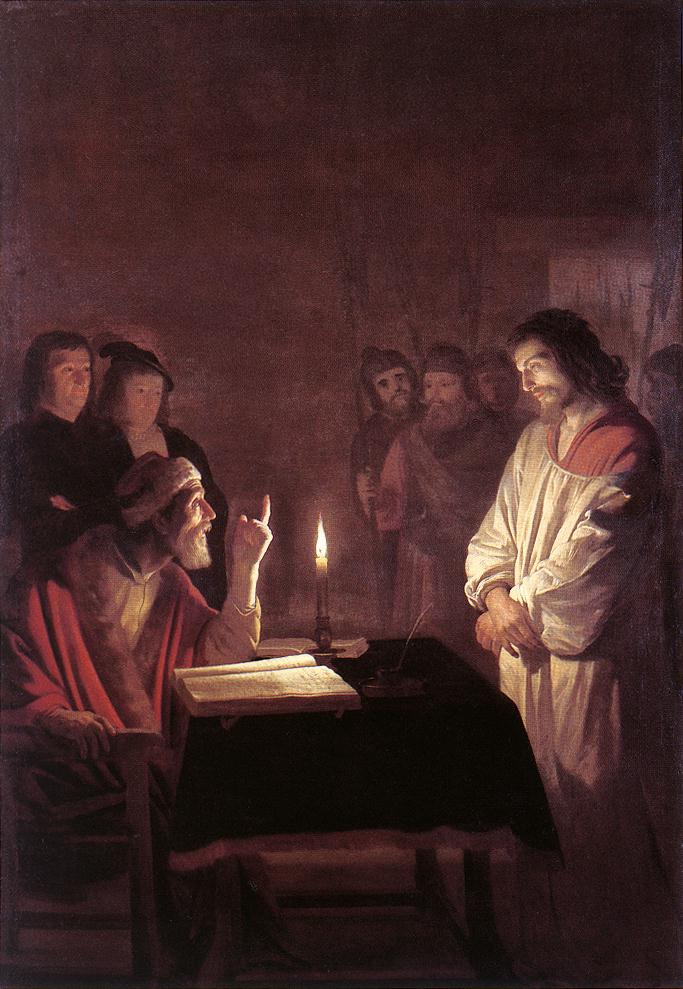
“Christ before the High Priest”
by Gerrit van Honthorst, c. 1617 |
Readings
for Saturday of the Thirtieth Week in Ordinary Time [2]
Readings
from the Jerusalem Bible [3]
Readings and Commentary: [4]
Reading 1: Philippians 1:18b-26
Brothers and sisters:
As long as in every way, whether in pretense or in truth,
Christ is being proclaimed, and in that I rejoice.
Indeed I shall continue to rejoice,
for I know that this will result in deliverance for me
through your prayers and support from the Spirit of Jesus Christ.
My eager expectation and hope
is that I shall not be put to shame in any way,
but that with all boldness, now as always,
Christ will be magnified in my body,
whether by life or by death.
For to me life is Christ, and death is gain.
If I go on living in the flesh, that means fruitful labor for me.
And I do not know which I shall choose.
I am caught between the two.
I long to depart this life and be with Christ,
for that is far better.
Yet that I remain in the flesh is more necessary for your benefit.
And this I know with confidence,
that I shall remain and continue in the service of all of you
for your progress and joy in the faith,
so that your boasting in Christ Jesus may abound on account of me
when I come to you again.
-------------------------------------------Commentary on
Phil 1:18b-26
St.
Paul writes from imprisonment, and begins this passage rejoicing that the
Gospel of Christ is being proclaimed, even though it is others who are doing
so. He goes on to express a feeling of his mortality which he couples with a
sense of longing to be with Christ in his heavenly kingdom. Still, the apostle
feels called to remain on earth to continue the work the Lord intended for him.
We hear this same interior debate in 2 Corinthians 5:1-10 as he
refers to our “earthly dwelling.”
“Paul
earnestly debates his prospects of martyrdom or continued missionary labor.
While he may long to depart this life and thus be with Christ, his overall and
final expectation is that he will be delivered from this imprisonment and
continue in the service of the Philippians and of others. In either case,
Christ is central; if to live means Christ for Paul, death means to be united
with Christ in a deeper sense.” [5]
CCC: Phil
1:21 1010, 1698; Phil 1:23 1005, 1011, 1021, 1025; Phil 1:27 1692
-------------------------------------------Responsorial Psalm: Psalm 42:2, 3, 5cdef
R. My soul is thirsting for the living God.
As the hind longs for the running waters,
so my soul longs for you, O God.
R. My soul is thirsting for the living God.
Athirst is my soul for God, the living God.
When shall I go and behold the face of God?
R. My soul is thirsting for the living God.
I went with the throng
and led them in procession to the house of God.
Amid loud cries of joy and thanksgiving,
with the multitude keeping festival.
R. My soul is thirsting for the living God.
-------------------------------------------Commentary on
Ps 42:2, 3, 5cdef
Psalm
42 (paired with Psalm 43) is an individual lament. Sung near the origin
of the Jordan River at Mt. Hermon, the singer laments not being in God’s
presence in the temple of Jerusalem. The great pain expressed flows from
being separated from the holy spaces of the house of God.
CCC:
Ps 42:3 2112
-------------------------------------------Gospel: Luke 14:1, 7-11
On a sabbath Jesus went to dine
at the home of one of the leading Pharisees,
and the people there were observing him carefully.
He told a parable to those who had been invited,
noticing how they were choosing the places of honor at the table.
“When you are invited by someone to a wedding banquet,
do not recline at table in the place of honor.
A more distinguished guest than you may have been invited by him,
and the host who invited both of you may approach you and say,
‘Give your place to this man,’
and then you would proceed with embarrassment
to take the lowest place.
Rather, when you are invited,
go and take the lowest place
so that when the host comes to you he may say,
‘My friend, move up to a higher position.’
Then you will enjoy the esteem of your companions at the table.
For everyone who exalts himself will be humbled,
but the one who humbles himself will be exalted.”
-------------------------------------------Commentary on
Lk 14:1, 7-11
This parable, found only in the Gospel of St. Luke, gives us
Jesus teaching the need for humility. The Lord’s indirect criticism of those
who seek the attention of the rich, and ignore the poor, sets the stage for the
next passage and the parable of the great banquet. Jesus is giving some wisdom
of his own. He first speaks of the charism of humility using the example of a
feast (just like the one to which he was invited), saying that one should
assume the lowly station and be invited up, rather than assuming the higher
station and being dismissed.
CCC: Lk
14:1 575,
588
-------------------------------------------Reflection:
The
Gospel parable from St. Luke requires that we examine humility, our own virtue,
with regards to pride and our desire to assimilate into the secular culture.
True humility can only come if a person has faith in God! It will flow from the
knowledge that God is omniscient, and always present in his triune nature,
creator of all that is. How can personal pride stand when we know that not only
did God create us, and give us life in the flesh, but also gave up his only Son
so that we could enjoy eternal life? Can a person who recognizes that they owe
everything that they have and are to God be prideful, self-indulged, or
self-absorbed?
Going
even further, once we understand that the Savior of mankind walks with us
daily, that, through the Holy Spirit, he is with us constantly, how can we take
pride in our own actions that serve God’s purpose? It is his strength and
wisdom poured out for us that allows us to do what we do. And even further
still, if we also know that God not only created and gave us life, but also
created and gave life to all living creatures, how could we disrespect the
dignity of another person or casually destroy God’s creation?
True
and virtuous humility comes from faith in God. That same faith demands that we
also respect ourselves, the very personal gift God gave us. How can we think
that we are anything but beautiful in the eyes of God? We are his favorite
creation, and he loves us more than anyone can imagine. Who are we to think
poorly of ourselves? In humility we must prize what we are as God created us.
As
the Lord tells the Pharisees in the Gospel: “For everyone who exalts himself will be humbled, but the one who
humbles himself will be exalted.” In all humility we must respect others,
not because they demand respect, but because they too are loved by God. It is
the great paradox of faith that, in humility, we are glorified. Today we pray
that our faith in the Father, his Only Son, and the Holy Spirit, inspire us
with awe and wonder, imparting to us true humility and grace.
Pax
[1]
General Norms for the Liturgical Year and the Calendar
Miscellaneous Notes no. 5.
[2]
The picture is “Christ before the High Priest” by Gerrit van Honthorst, c.
1617.
[3]
S.S. Commemoratio[4]
The readings are taken from the New American Bible,
with the exception of the psalm and its response which were developed by the
International Committee for English in Liturgy (ICEL). This republication is
not authorized by USCCB and is for private use only.[5]
NAB footnote on Philippians 1:19-25.

No comments:
Post a Comment