|
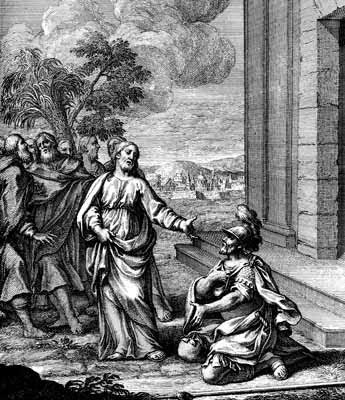
“The Faith of the Centurion”
by Caspar Luiken (1712) |
Readings for Saturday of the
Twelfth Week in Ordinary Time [2]
Readings from the Jerusalem
Bible [3]
Readings and Commentary: [4]
Reading 1: Genesis 18:1-15
The LORD appeared to Abraham
by the Terebinth of Mamre,
as Abraham sat in the
entrance of his tent,
while the day was growing
hot.
Looking up, he saw three men
standing nearby.
When he saw them, he ran from
the entrance of the tent to greet them;
and bowing to the ground, he
said:
"Sir, if I may ask you
this favor,
please do not go on past your
servant.
Let some water be brought,
that you may bathe your feet,
and then rest yourselves
under the tree.
Now that you have come this
close to your servant,
let me bring you a little
food, that you may refresh yourselves;
and afterward you may go on
your way."
The men replied, "Very
well, do as you have said."
Abraham hastened into the
tent and told Sarah,
"Quick, three measures
of fine flour!
Knead it and make
rolls."
He ran to the herd, picked
out a tender, choice steer,
and gave it to a servant, who
quickly prepared it.
Then Abraham got some curds
and milk,
as well as the steer that had
been prepared,
and set these before them;
and he waited on them under
the tree while they ate.
They asked him, "Where
is your wife Sarah?"
He replied, "There in
the tent."
One of them said, "I
will surely return to you about this time next year,
and Sarah will then have a
son."
Sarah was listening at the
entrance of the tent, just behind him.
Now Abraham and Sarah were
old, advanced in years,
and Sarah had stopped having
her womanly periods.
So Sarah laughed to herself
and said,
"Now that I am so
withered and my husband is so old,
am I still to have sexual
pleasure?"
But the LORD said to Abraham:
"Why did Sarah laugh and say,
'Shall I really bear a child,
old as I am?'
Is anything too marvelous for
the LORD to do?
At the appointed time, about
this time next year, I will return to you,
and Sarah will have a
son."
Because she was afraid, Sarah
dissembled, saying, "I didn't laugh."
But he replied, "Yes you
did."
-------------------------------------------
Commentary on Gn 18:1-15
Abraham and Sarah
encounter God and two messengers in this selection from Genesis. Abraham
recognizes the Lord (we note his act of obeisance and form of address “’ădonāy”)
and acts as is required by oriental hospitality providing rest, drink, and
food. It is clear that the Lord is the key figure in the story. The messengers
are soon forgotten as Abraham hears God’s prediction that he would return, and
when he did Abraham and Sarah would have a son. When Sarah hears this, she
laughs. Sarah's laughter is actually a bit of ironic coloring. We recall
in Genesis 17: 17 that Abraham laughed when he was
first told he would bear a son. In Hebrew, the word is yitshaq,
which is identical to Isaac. The name Isaac means "he laughs." [5]
CCC: Gn 18:1-15 706, 2571
-------------------------------------------
Responsorial Psalm: Luke 1:46-47, 48-49, 50 and 53, 54-55
R. (see 54b) The Lord has remembered his mercy.
"My soul proclaims the
greatness of the Lord,
my spirit rejoices in God my
Savior."
R. The Lord has remembered
his mercy.
"For he has looked with
favor on his lowly servant.
From this day all generations
will call me blessed:
the Almighty has done great
things for me,
and holy is his Name."
R. The Lord has remembered
his mercy.
"He has mercy on those
who fear him
in every generation.
He has filled the hungry with
good things,
and the rich he has sent away
empty."
R. The Lord has remembered
his mercy.
"He has come to the help
of his servant Israel
for he has remembered his
promise of mercy,
The promise he made to our
fathers,
to Abraham and his children
for ever."
R. The Lord has remembered
his mercy.
-------------------------------------------
Commentary on Lk 1:46-47, 48-49, 50 and 53,
54-55
The responsorial
is the Magnificat, the beautiful Canticle of Mary. Her song of thanksgiving and
humility captures the saintliness that has become synonymous with our image of
Mary the Mother of God, the Queen of Heaven, and the Mother of the Church. In her
dedication to service, she offers herself to God as vessel of the Messiah. She
sets the stage for the humble birth of Jesus.
Lk
1:46-55 722, 2619, 2675; Lk 1:46-49 2097; Lk 1:48 148, 971, 2676; Lk 1:49 273, 2599, 2807, 2827; Lk 1:50 2465; Lk 1:54-55 706; Lk 1:55 422
-------------------------------------------
Gospel: Matthew 8:5-17
When Jesus entered Capernaum,
a centurion approached him
and appealed to him, saying,
"Lord, my servant is
lying at home paralyzed, suffering dreadfully."
He said to him, "I will
come and cure him."
The centurion said in reply,
"Lord, I am not worthy
to have you enter under my roof;
only say the word and my
servant will be healed.
For I too am a man subject to
authority,
with soldiers subject to me.
And I say to one, 'Go,' and
he goes;
and to another, 'Come here,'
and he comes;
and to my slave, 'Do this,'
and he does it."
When Jesus heard this, he was
amazed and said to those following him,
"Amen, I say to you, in
no one in Israel have I found such faith.
I say to you, many will come
from the east and the west,
and will recline with
Abraham, Isaac, and Jacob
at the banquet in the Kingdom
of heaven,
but the children of the
Kingdom
will be driven out into the
outer darkness,
where there will be wailing
and grinding of teeth."
And Jesus said to the
centurion,
"You may go; as you have
believed, let it be done for you."
And at that very hour his
servant was healed.
Jesus entered the house of
Peter,
and saw his mother-in-law
lying in bed with a fever.
He touched her hand, the
fever left her,
and she rose and waited on
him.
When it was evening, they
brought him many
who were possessed by demons,
and he drove out the spirits
by a word and cured all the sick,
to fulfill what had been said
by Isaiah the prophet:
He took away our infirmities
and bore our diseases.
-------------------------------------------
Commentary on Mt 8:5-17
This selection describes the second and third healing
episodes (out of nine) found in St. Matthew’s Gospel. Once again, these
encounters serve as proofs of the Lord’s identity as the Messiah. Clear
evidence is given of this purpose with the use of the quote: “He took away
our infirmities and bore our disease,” taken from the "suffering
servant" oracle in Isaiah
53:4.
This didactic passage also contains the centurion's humble
profession of faith used in the liturgy of the Mass: "'Lord, I am not
worthy to have you enter under my roof; only say the word and my servant [soul] will
be healed.'"
"Centurion": an officer of the Roman army in
control of one hundred men. This man's faith is still an example to us. At the
solemn moment when a Christian is about to receive Jesus in the Blessed
Sacrament, the Church's liturgy places on his lips and in his heart these words
of the centurion, to enliven his faith: Lord, I am not worthy." [6]
CCC:
Mt 8:8 1386; Mt 8:10 2610; Mt 8:11 543; Mt 8:17 517, 1505
-------------------------------------------
Reflection:
Sacred Scripture provides a
nice contrast of attitudes today. In the
first reading we hear the story of Abraham and Sarah’s encounter with God and
two angels. In spite of the fact that
Abraham had been told earlier that he and Sarah would have a son (and he
laughed), when he is told a second time, Sarah laughs in disbelief (in some
ways worse, she also denies that she laughed).
The authors of Genesis actually used a bit of irony in that the Hebrew
word used for laughter is identical to the name Isaac; in fact, the name Isaac
means “he laughs.” In the case of Abraham and Sarah, God has established a
covenant and, although they lack faith in this promise, the Lord will
ultimately deliver on his promise to them.
This encounter contrasts
directly with the account of Jesus’ meeting with the centurion. In the second instance, the centurion
demonstrates immediately that he has faith in the identity of Christ and the
ability of God to heal his servant. His
faith is rewarded with Christ’s healing word; the faith of the centurion is
justified.
Also contrasting with Abraham
and Sarah’s skepticism about God’s willingness to intervene in their lives is
the Canticle of Mary that is used as the psalm response. Mary’s unconditional surrender to the will of
God is the ultimate expression of faith as she offers her soul to God.
We are challenged by these
tales of God’s interaction with his favorite creation. We ask God today to open our hearts to the
miracles God offers us daily. We pray
that like the centurion, when we encounter the trials of this life we might
offer our anxiety to the Lord, with faith that his will be done. We pray that like the Blessed Virgin, we
might offer ourselves to God with complete confidence and accept his grace.
Pax
[1]
General
Norms for the Liturgical Year and the Calendar Miscellaneous Notes no. 5:
“Outside Advent, Christmas Time, Lent, and Easter Time, on Saturdays which have
no commemoration having the rank of Obligatory Memorial or higher, a Mass in
honor of the Blessed Virgin Mary may be celebrated. This is indicated in the
calendar by “BVM.” The readings and prayers may be selected from the
Collection of Masses of
the Blessed Virgin Mary.”
[2]
The picture used is “The Faith of the Centurion” by
Caspar Luiken (1712).[3]
S.S. Commemoratio[4]
The readings are taken from the New American Bible,
with the exception of the psalm and its response which were developed by the
International Committee for English in Liturgy (ICEL). This republication is
not authorized by USCCB and is for private use only.[5]
Ignatius Catholic Study Bible, Genesis © 2010, Ignatius Press, San Francisco,
CA. p. 40.
[6]
The Navarre Bible, “Gospels and Acts,” Scepter Publishers, Princeton, NJ, ©
2002, p. 101.